

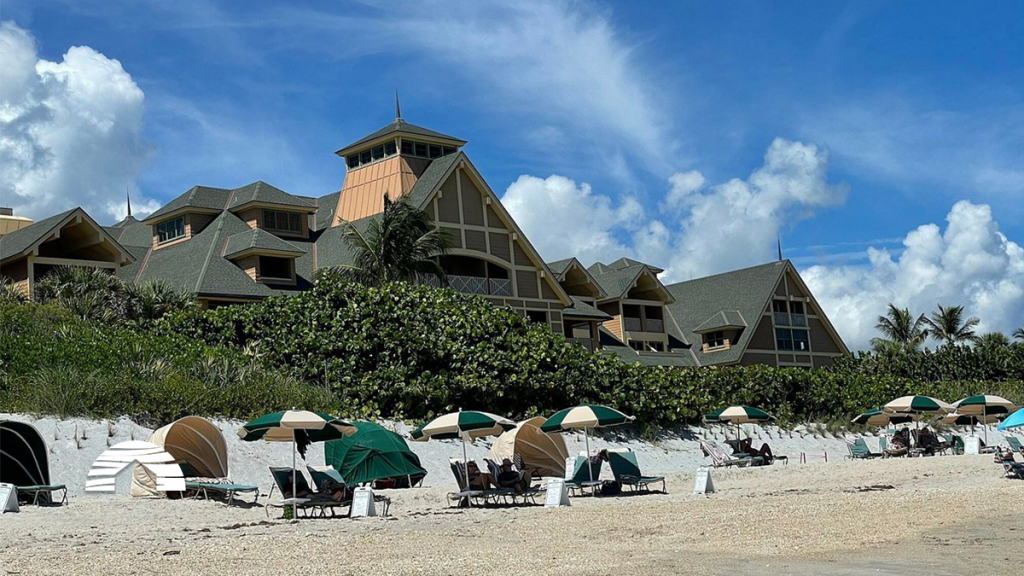


Think owning a timeshare means staying at the same resort each year? Think again! There are many types of timeshares, from flexible weeks to elaborate points-based systems. In this guide, we’ll go over all the ownership and usage models you’re likely to encounter so you can make an informed decision when shopping on the secondary market. Let’s get started!
Types of Timeshares: Ownership Models


If you’ve read other blogs on our site, you’ve probably seen us mention that timeshares are real estate. However, things are a little more nuanced than in the housing market. Timeshare ownership is spread among many people, and some are at international destinations, where actual ownership is difficult for non-citizens.
Some types of timeshares have deeds, allowing them to be treated like any other asset. Other timeshares use alternative ownership models, like leased timeshares. A few use a fractional ownership model, functioning more like a shared home than a single hotel getaway. It can be a bit overwhelming at first, so let’s go step by step.
Types of Timeshares: Deeded Timeshares
Most types of timeshare in the United States use a deeded ownership model. It’s the oldest and most established model in the industry, and probably the least complicated. When you buy a deeded timeshare, you’re purchasing an ownership stake in a resort. So if you own a timeshare at Westgate Las Vegas, you’re literally a partial owner of that property. Well, with an asterisk, anyway.
You can’t go to Wilderness Lodge, point at a specific chunk of land, and say “This is mine”. Timeshare ownership is more abstract than that. Instead, you have an ownership interest. Your ownership is somewhat diffused throughout the property, and the tangible benefit is the ability to stay there for a certain amount of time each year. We’ll go over the usage models later, but even points-based timeshares use this ownership model.
Because deeded timeshares are actual property, you can sell, gift, and pass them down to heirs. They also usually come with a perpetuity clause. Once you buy it, you own it forever. That’s great if you want to create lasting vacation memories, but it also means you’re obligated to pay annual maintenance fees. The only ways out of the contract are through property transfer or foreclosure.
Right of First Refusal
Most timeshare developers have a Right of First Refusal (ROFR) clause in their ownership contracts. You still own your timeshare, but if you choose to transfer ownership, the developer has the opportunity to review and potentially intercept the sale. They take the place of the buyer, and the transfer continues under the agreed upon terms. If you sell your timeshare, you still get paid, but your original buyer gets their money back.
The Right of First Refusal is part of your contract with the developer, rather than a law. As such, the way it works depends on the wording of your contract. Some contracts allow ROFR to be invoked only during a sale, making gifting safe. Others consider any transfer of ownership to be eligible to ROFR. There may be exceptions for immediate family members, or you can pay a fee to have the developer waive their right. Review your contract and deed for more information.
Types of Timeshares: Right-To-Use Timeshares
A Right-To-Use (RTU) timeshare is a non-deeded form of vacation ownership. Unlike a deeded timeshare, you don’t actually have an ownership stake in the resort. Instead, you own the right to stay at that resort for a certain amount of time each year. For the average traveler, there’s not really a tangible difference. However, there are some important legal distinctions.
RTU timeshares exist to get around international property law. For instance, unless you’re a Mexican citizen, you legally can’t own property within 31 miles (50 km) of the coast. This would obviously make it hard to buy a timeshare in Cabo, so RTU timeshares offer a loophole. The actual property is either owned by a Mexican citizen or a trust fund, but timeshare owners can still use it.
The biggest limitation of RTU timeshare ownership is the expiration date. Unlike deeded timeshares, RTU timeshares can’t have a perpetuity clause. They have to expire, though the actual date may not be for several decades. The expiration date doesn’t reset upon property transfer, either. If you’re buying an RTU timeshare on the resale market, confirm how many years are left on it. Some buyers might find shorter contracts desirable, since it means fewer annual fees, but you want to at least be able to get your money’s worth out of the timeshare.
Types of Timeshares: Leasehold Timeshare
Leasehold timeshares are the halfway point between RTU and deeded timeshare ownership. Like a deeded timeshare, you’re buying ownership interest in real estate. You may even get a deed! However, like an RTU timeshare, your ownership has a hard expiration date.
The Disney Vacation Club is the most prominent example of a leasehold timeshare. DVC contracts expire 50 years after the resort’s opening. However, Disney may offer to extend these contracts in the future. They’ve already done so once, with Old Key West Resort.
Leasehold timeshares may have more complicated ownership transfer rules than other timeshares, particularly regarding inheritance. Check your ownership documents to determine your options.
Types of Timeshares: Fractional Ownership
Fractional ownership is the deeded timeshare distilled to its purest form. In this ownership model, you own a tangible, real asset. There is a place you can travel to where you can stand in a room, spread out your arms, and shout, “I OWN THIS!” at the top of your lungs. Don’t do that, though, you’ll upset the neighbors.
Fractional ownership provides a larger portion of time at a resort compared to traditional timeshares, allowing for more frequent visits. You and a limited number of other fractional owners each own a stake in a real property. This is more expensive than a traditional timeshare because your stake is much larger. Rather than sharing the timeshare with 51 other owners, limiting you to a single week, you share it with 3 to 12 other owners. These weeks might not be consecutive, depending on the ownership contract. You might get one week a quarter, or you could get an uninterrupted month. It depends.
Some resorts, like Four Seasons Aviara, operate under this shared ownership model, combining resort amenities with the benefits of a shared deeded ownership interest. This sort of luxury is more expensive than a traditional timeshare, but still far more affordable than a traditional vacation property.
Types of Timeshares: Use Models and Subtypes
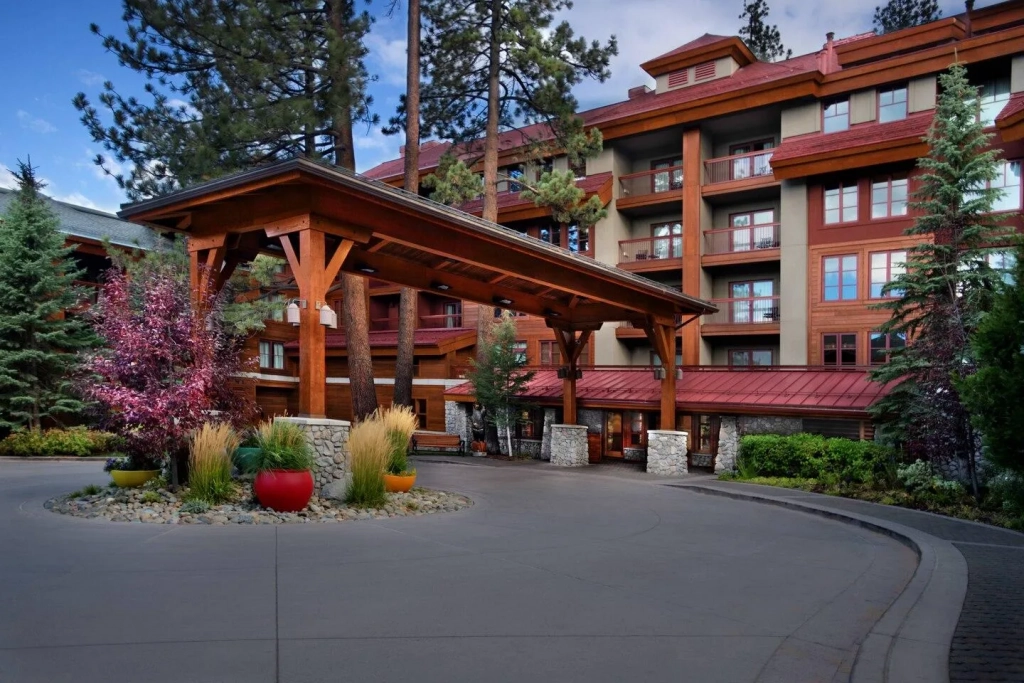
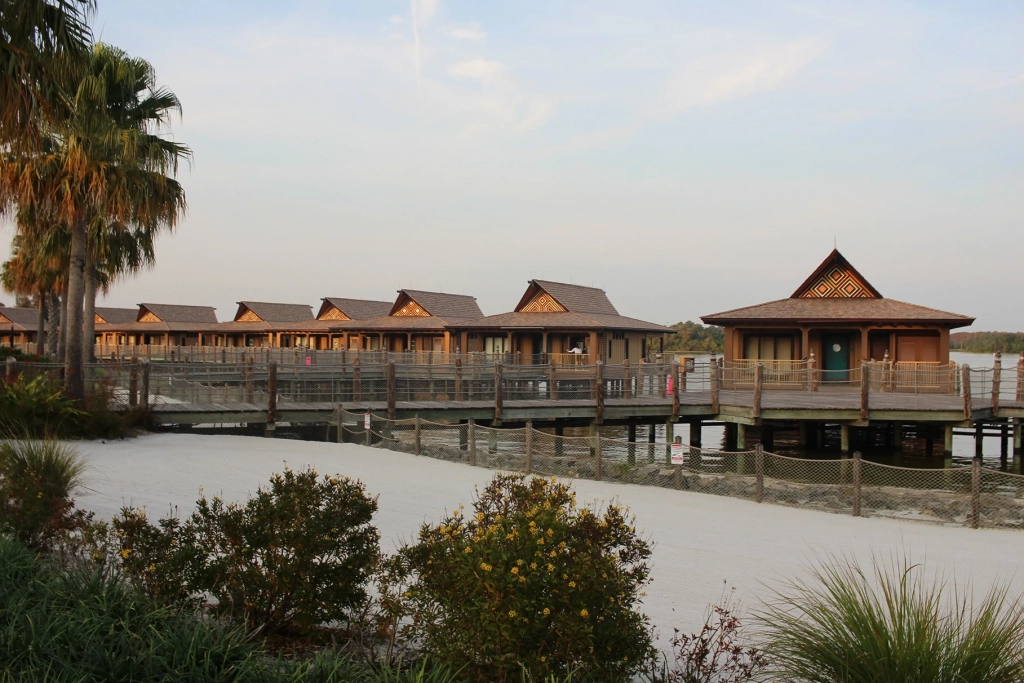
Just as there are many different types of timeshare, there are also many different types of usage models. A timeshare’s usage model is what determines when a specific owner can use the property. We can boil it down to two types of timeshares: week-based and points-based timeshares.
A week-based timeshare is the easiest to understand. You have a specific block of time, often a week, during which you can use the property. These are straightforward, reliable, and increasingly uncommon in the industry. Points-based timeshares are more flexible, but also more abstract. You can theoretically use the property whenever you want. You aren’t even limited to a single property, in many cases! However, there are limitations that make them more complicated to use than week-based timeshares.
There’s also the matter of frequency. Biennial timeshares can only be used on odd or even years, and some timeshares can have more unusual frequencies. These are less expensive and have lower maintenance fees, but limit your actual use time.
Finally, you can put your timeshare on a vacation exchange like RCI or Interval International, converting it into points you can use on other vacations. However, the number of points you receive depends on the trading power of your timeshare. We’ll go over everything in more detail in the following sections.
Types of Timeshares: Fixed-Week Timeshares
Fixed weeks are the original timeshare model, dating back to the 1960s. Under this model, your ownership interest represents a specific week in the year, numbered 1 through 52. Weeks are based on the weekend at most resorts: Week 1 ends with the first weekend of the year, Week 2 with the second, and so on. Not all resorts use this exact calendar, but the general principle is the same.
Individual weeks sell for different amounts, depending on the demand. This usually depends on a combination of location and climate, like winter weeks being popular at ski resorts. They can also vary depending on holidays, the school year, local festivals, and other factors. The final weeks of the year tend to be among the most lucrative, as people love travelling for the winter holidays.
Fixed-week timeshares are also the easiest to use. In most cases, your reservation is pre-booked. You’re in the same unit at the same resort, in the same week each year. There’s no booking window, no fear of overbooking, no unexpected price surges. All you need to do is show up.
This model may be too rigid for some timeshare owners, but there’s a hidden benefit. Fixed-week timeshares can carry significant trading power in vacation exchanges, especially during peak season. If you ever need a change of scenery, a particularly popular week can be turned into a decent chunk of points.
Types of Timeshares: Floating-Week Timeshares
Floating weeks are a more flexible approach to timeshare ownership, though not as flexible as points. With this model, you still own a week’s worth of time, but you get to choose when you use it. Instead of being assigned a specific week, these types of timeshare are associated with seasons. However, these aren’t the seasons as you typically understand them.
Rather than relying on meteorological seasons, like summer or winter, floating timeshares use a resort-specific calendar to determine when you can use your week. These seasons don’t need to be linear or of a consistent length, either: they’re based on demand. Some resorts have peaks and divots in demand on certain dates. Others have a consistent demand, and thus only a single season. Some, like Tahiti Village in Las Vegas, have only two seasons: one for the week of Christmas and one for everything else!
To stay at a floating timeshare, you need to book your stay in advance. There’s no guarantee, unlike with fixed weeks. However, since weeks are sold by season, there’s less competition for booking than in a points-based timeshare. There are only so many weeks out there, after all.
Floating timeshares also introduce the concept of a home resort. This is a concept exclusive to vacation clubs, where members can stay at multiple affiliated resort locations. Your home resort is the property you have an ownership interest in. Most vacation clubs give owners priority booking privileges at their home resort, allowing them to book stays earlier than other members. Home resorts are only relevant for floating week timeshares that allow you to stay at multiple properties, but they’re critical for understanding points-based timeshare ownership.
Types of Timeshares: Points-Based Timeshares
Points-based timeshares are the most common type of timeshare today due to their flexibility, and they’re the model you’re most likely to encounter when buying a new timeshare from a large developer like Disney, Hilton, or Wyndham. Under this model, owners purchase an annual allotment of points. You then use these points to secure a stay at an affiliated resort. You’ll typically see vacation clubs use this system, since the ability to stay at multiple resorts is part of the appeal.
Points are an abstract representation of a timeshare interest. They’re usually connected to a specific home resort, though some vacation clubs use a trust system instead. The home resort determines your maintenance fees, though you also get priority booking there.
Points work like vacation currency. Much like with floating week timeshares, points-based systems use a seasonal calendar. Rooms cost a different number of points depending on the season and unit type. However, unlike with floating week timeshares, the price can vary by the day. For instance, some points-based timeshares charge more points for weekend stays.
Another key difference with points-based timeshares is the length of stay. A week-based timeshare entitles you to a week-long stay. You may be able to split that week, but you’re still staying for seven days. Points-based timeshare ownership lets you stay for single days, weekends, or multiple weeks, depending on your point budget. A week-long stay in the peak season might be worth multiple weeks in the off-season!
Biennial Timeshares and Other Frequency Types
Most types of timeshare contracts allow you to stay at a resort every year. However, some less expensive timeshares may only allow you to stay in certain years. Typically, these timeshares are biennial and can only be used in even or odd-numbered years. Some timeshares have more unusual frequency intervals, however.
You’re most likely to find these unusual frequencies as part of a fractional ownership. In these cases, it’s not typically a year-off/year-on situation. Instead, you might get an extra week every few years. Since fractional ownership is negotiated between a smaller group of people, you can encounter just about anything.
Points-based timeshares don’t usually use this system, but they do offer something similar. These timeshares often allow you to bank points from the previous year or borrow points from a future one. This allows you to approximate the experience of having a less expensive timeshare, which you can only use every few years, if that seems appealing.
Before you buy one of these timeshares, you should calculate the savings. Biennial timeshares offer only half the time of annual ownership, so they should ideally cost around half as much. However, the resale market doesn’t always work that way. Make sure you’re actually saving a worthwhile amount of money before you commit!
Vacation Exchanges
A vacation exchange allows you to trade your timeshare for points you can use at other resorts. These resorts don’t have to be part of the same vacation club. They don’t even necessarily need to be timeshares! You can even use these points to book tours, flights, or cruises.
You typically need to pay membership and exchange fees when using a vacation exchange, though some timeshare developers may let you waive the fees. Either way, the amount of vacation points you get on the exchange depends on how desirable your timeshare is. If you have a fixed week timeshare, the biggest factor will be the combination of your resort, unit type, and use week. If you have a points-based contract, your annual point allotment and home resort will determine the value.
Using a vacation exchange isn’t the same as selling your timeshare. You’ll still be able to use it in future years! However, it’s a good way to inject some new life into your vacation ownership if things are feeling stale.
Buying a Timeshare with Timeshare Broker Associates


Here at Timeshare Broker Associates, we specialize in the secondary timeshare market. We’re one of the most trusted resellers in the industry, and we have decades of experience helping people like you find a timeshare that fits their needs. If you’re interested in vacation ownership, buying a timeshare resale is the best way to get started. Prices on the secondary market are much more affordable than buying from the developer, so you can get more vacation for less money. However, even though our site makes it easy to browse listings, you should still do your due diligence!
Tips for Timeshare Purchases
Let’s start by taking a look at one of our listings. This is an example listing for Disney’s Grand Floridian Resort in Orlando. You may need to zoom in for a closer look if you’re on mobile.
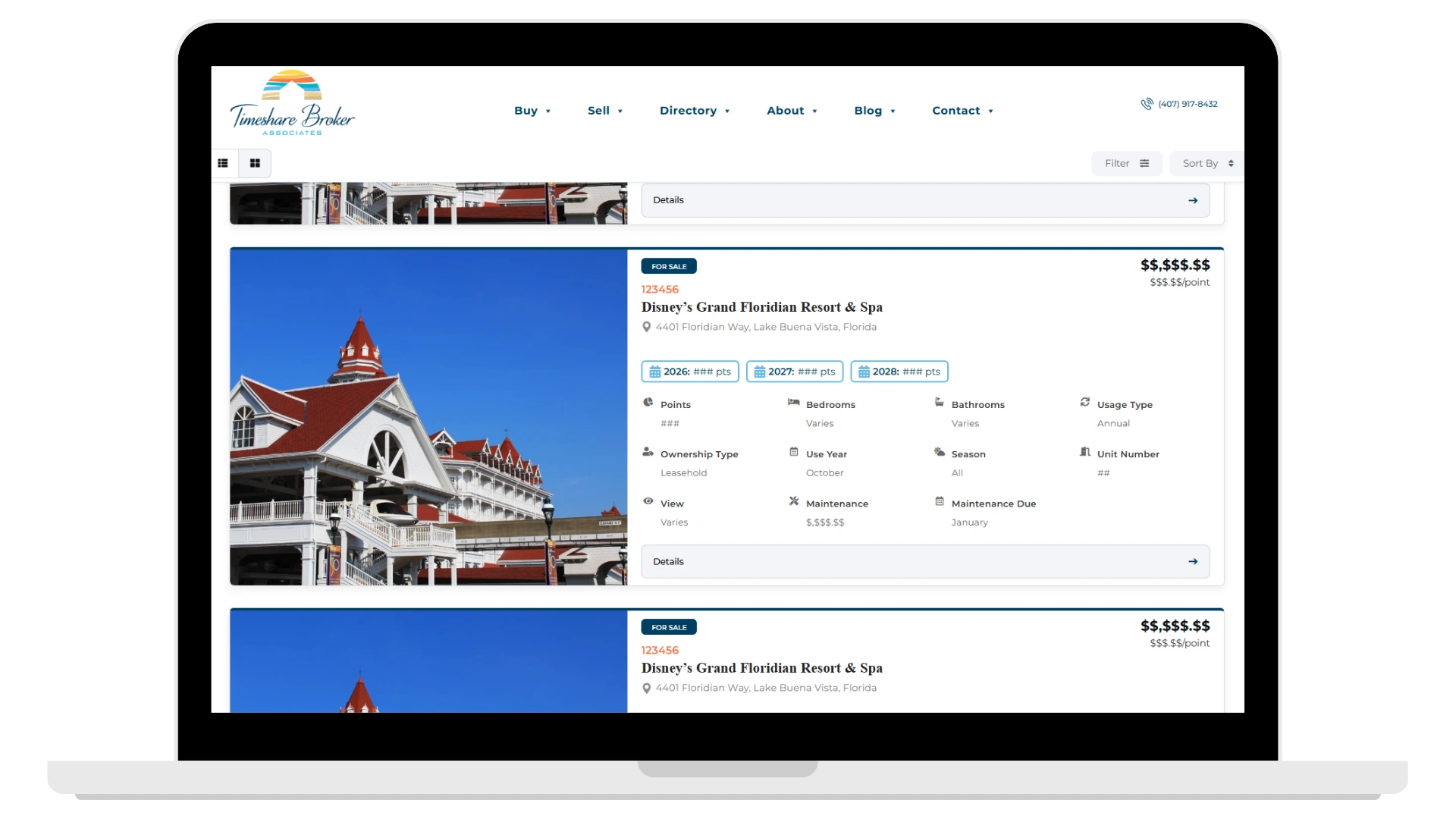
At the top right of the image, you’ll see the purchase price. For points-based timeshares, we also list the price per point. There’s no set point value between vacation clubs, but it’s a useful tool for comparing similar listings.
Below that, in the blue boxes, you’ll see the point allotments for the next three years. This is important for point-based timeshares, as owners may rent, exchange, or use their points during the sale process. It can also help you see if the owner has any banked or borrowed points. Those are attached to the timeshare contract, so if you buy it, those points go to you!
Here’s a summary of the other information you’ll find in one of our listings.
Timeshare Listing Overview
The Listing Doesn’t Cover Everything
We try our best to be as transparent as possible with our listings, but we can’t cover everything. You’ll want to research the timeshare developer before you make a commitment. Their official website is a good place to start, but you can also check Reddit, Facebook groups, and other timeshare-owner communities for advice. You should also ask for a full copy of the contract after finding a potential seller. Identifying potential pain points can lead to a smoother ownership experience.
You should also take a moment to research any resale restrictions. Timeshare companies impose restrictions on resale contracts to encourage direct sales. For instance, if you buy points at Disney’s Riviera Resort on the resale market, you’d need to pay a $500 contract administration fee. You also wouldn’t be eligible for DVC perks like member events, exclusive merchandise, and lounge access unless you had already purchased points from Disney. There are even resort-specific limitations: resale points bought at Riviera can only be used at Riviera. Identifying these limitations can help you identify the timeshare that works best for you.
Use Vacation Rentals to Test Different Types of Timeshare
Not sure if a timeshare is right for you? Want to compare multiple timeshare options? Take one for a test run! Because timeshare properties are real estate, owners can rent them out at their discretion. We recommend using BuyATimeshare.com to find timeshares for rent, but you can also find timeshare vacation rentals on services like Airbnb and VRBO.
Vacation rentals are a strong way to try different types of timeshares. There are no long-term commitments with a vacation rental, and you’re not obligated to attend a presentation. It’s a great way to get a feel for a vacation lifestyle before signing a timeshare contract.
How to Choose Between Types of Timeshares
Now that you’ve done your research, you should have a better idea of what type of timeshare you want to buy. If you still need some guidance, here’s how to narrow things down.
Consider Your Budget
Timeshares are a long-term commitment, and even those that expire may not do so in your lifetime. While you can find fantastic deals on the resale market, make sure you know what you’ll be paying before jumping in! That means looking beyond the purchase price and going into the details.
First, check the annual maintenance fee. We include that in every listing, so it’s easy to find. Compare that with any news you can find about the history of rate increases. You should also check whether there have been special assessments: these are additional charges used to fund major resort upgrades or repairs. Just remember, you can’t “cancel your timeshare sub” the same way you would your Netflix. Make sure you’re comfortable paying this fee in perpetuity!
You’ll also want to learn about any title transfer fees and administrative fees, as well as the expected closing costs. The buyer traditionally pays these in a timeshare sale, but some sellers will pay them as an incentive.
Consider Your Travel Habits
Timeshares are a vacation lifestyle product: they’re designed for people who take vacations annually, or at least regularly. If you’ve gotten this far into researching the potential benefits of a timeshare, you’re probably someone who vacations often enough for one to be worthwhile. Biennial timeshares and points-based timeshares are a good option for people who don’t want to take a yearly vacation.
You should also consider whether you’re interested in taking a wide variety of vacations or prefer a consistent vacation tradition. Do you like going to the same destination each year, at around the same time? A fixed-week timeshare is a good fit. Do you need more flexibility? Consider a floating period timeshare or points.
Long-Term Planning
According to the American Resort Development Association (ARDA), More than 9.9 million people in the U.S. own one or more timeshares, and 90% of them are satisfied with their purchase. However, to avoid falling into that 10%, it’s a good idea to figure out how your timeshare fits into your long-term plans. How will your timeshare affect you and your family in the long-term?
Timeshare contracts are often binding, making it difficult for owners to exit their agreements if their financial or personal circumstances change. You own them forever, and they become part of your estate. If you own one of these, it’s a good idea to talk to your family about what will happen when you can no longer use the timeshare. Many vacation clubs waive ownership transfer fees when gifting a timeshare to immediate family or bequeathing it to an heir. However, you should confirm that the recipient is both interested in and willing to take responsibility for the timeshare property.
If no one in your family is interested in taking on your timeshare, have an exit strategy. Here at Timeshare Broker Associates, we’re happy to help you sell your timeshare, but it’s not a real estate investment. The resale process can take time, and you’re likely to sell at a loss. Check whether the timeshare company has an official exit program first.
Forever is a long time, which is why some people prefer RTU and leased timeshares. The expiration dates provide a sense of comfort and closure. However, if that timeshare isn’t set to expire for fifty years, it’s effectively perpetual. Check the development’s rules on inheritance and ownership transfer before you commit.
FAQs
Taking the Next Steps
Ready to buy some vacation real estate? Let us help you take the next steps. Timeshare Broker Associates is one of the most trusted names in the timeshare industry. We’re recognized by the American Resort Development Association and the Better Business Bureau for our commitment to ethics and excellence. Let us help you navigate the timeshare market.
Want to get started? Click the button below to browse timeshare properties we have for sale. You can search by resort developer, resale price, destinations, and more. We even have tools to help you determine the ongoing costs of your purchase. Want more information? Call us at (407) 917-8432, or send us an email at [email protected]. You can also click the icon in the corner of your screen to chat with a live agent!